Padel at a glance
| Type | Racket sport, played almost exclusively as doubles |
|---|---|
| Court | 20m x 10m (66ft x 33ft), enclosed by glass and mesh walls |
| Racket | Solid, perforated, no strings, carbon or fiberglass over a foam core |
| Ball | Like a tennis ball, with slightly less pressure |
| Serve | Underhand, struck below waist height after one bounce |
| Scoring | Tennis scoring: 15, 30, 40, game; six games per set |
| Unique feature | Walls are in play, the ball rebounds off the glass like in squash |
| Invented | 1969, Acapulco, Mexico |
| Governing body | International Padel Federation (FIP) |
| Players worldwide | ~25–30 million across 90+ countries [1] |
How Padel Works
Padel (pronounced "PAH-del," not "paddle") is played by an estimated 25–30 million people across more than 90 countries, on 77,300 courts worldwide [1]. It is the second-most-played sport in Spain after soccer, and it officially arrived in America: 1,073,000 Americans played padel in 2025, the first year the SFIA tracked it [2]. If you've heard the name at your gym, on a podcast, or from a tennis friend who won't stop talking about it, this is what they're talking about.
The court. A padel court is a 20-by-10-meter rectangle enclosed in tempered glass and metal mesh, with a net across the middle. The enclosure isn't a fence; it's playing surface. After the ball bounces on your side, you can let it rebound off your back or side glass and return it. A ball that would be a lost point in tennis becomes a second chance in padel, which is why rallies run long even between beginners.
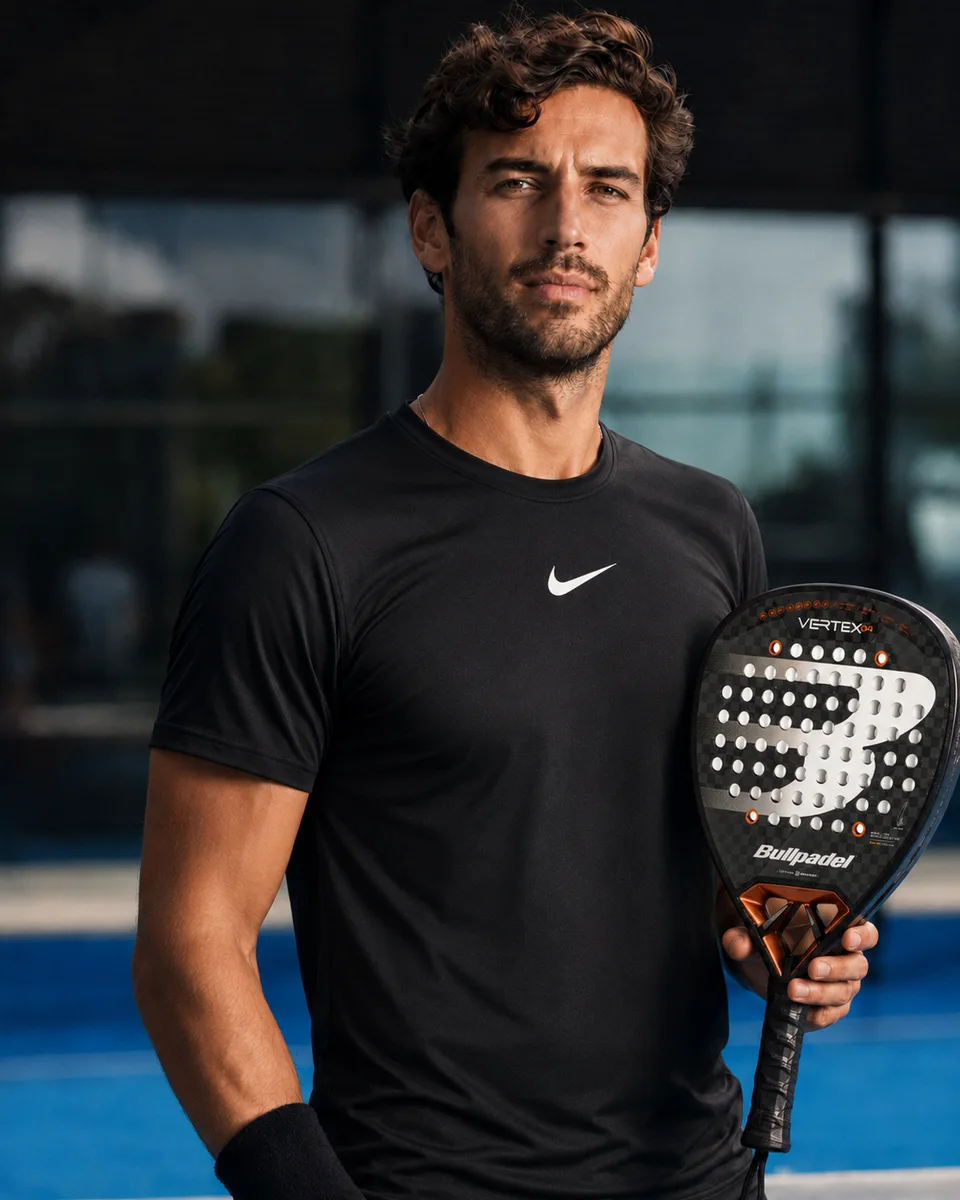
The equipment. A padel racket is a solid bat with a perforated face, no strings, made from carbon fiber or fiberglass wrapped around a soft foam core. Padel balls look identical to tennis balls but carry slightly less pressure, so they come off the glass at a playable speed. That's the entire kit: racket, balls, and court shoes.
The rules, in one paragraph. Padel rules are tennis rules with three changes. First, the serve is underhand: bounce the ball and strike it at or below waist height, diagonally. Second, walls are in play after the bounce, but a ball that hits the glass before bouncing is out. Third, the game is doubles: two versus two, always. Everything else (scoring, sets, lets, one bounce maximum) works like tennis.
Where Did Padel Come From?
Padel was invented in 1969 by Enrique Corcuera, a Mexican businessman who built a walled court at his home in Acapulco because his yard didn't have room for a full tennis court. His friend Alfonso de Hohenlohe brought the idea to Marbella, Spain in 1974, where it spread through Spanish tennis clubs; Argentina adopted it in the same era and made it a mass sport. For fifty years padel grew mostly in the Spanish-speaking world, today 12.7% of Spain's entire population plays [3], before exploding across Europe, the Middle East, and finally North America in the 2020s. The professional game is organized under Premier Padel, a global tour sanctioned by the FIP.
Why Is Padel So Popular?
Padel's growth, 14,355 new courts were built worldwide in a single year, a 15.2% jump [1], comes down to a short list of design choices that remove the reasons people quit other racket sports:
- Beginners rally on day one. The underhand serve removes tennis's hardest skill, and the walls keep the ball alive.
- It's social by design. Always doubles, on a small court, four people close enough to talk between points.
- Age and fitness matter less. Positioning beats power, so mixed ages and levels can genuinely play together.
- The ceiling stays high. Wall play adds a dimension that takes years to master, easy to start never means shallow.
- Matches fit real life. A padel match runs about 60–90 minutes, bookable by the hour.
Padel in the United States
Padel in the US is small but compounding fast. America counted 1,073,000 players in 2025 [2] and passed 1,000 courts in April 2026, with Florida, Texas, and California holding roughly 70% of them [4]. US Google searches for padel have grown about 62% per year since 2019 and crossed 100,000 monthly searches for the first time in July 2026, while searches for "padel courts near me" more than doubled in the last year alone. Industry projections put America at 3,000 courts by the end of 2026 [4]. The pattern matches every country padel has entered: courts arrive, and demand outruns them.
Is Padel the Same as Pickleball or Paddle Tennis?
No, padel is frequently confused with three other sports, and they are all different games:
- Pickleball uses flat paddles and a plastic wiffle ball on a small open court with no walls. Different equipment, court, and rules, see our full padel vs pickleball comparison.
- Paddle tennis (pop tennis) is played on a small tennis-style court with no walls and a lower net.
- Platform tennis ("paddle") is an American winter sport played on a raised, heated deck with taut chicken-wire screens.
What Do You Need to Play Padel?
The name is the giveaway: padel, the Spanish-derived spelling, always means the glass-court sport described on this page.
Three things: a racket (rent one at first, around $5-10 at most clubs), court shoes (running shoes are fine for session one), and balls (usually provided at beginner clinics). A first month of padel typically costs $60-100 including a group clinic. When you're ready, our step-by-step guide to getting started with padel covers finding a court, booking a clinic, and choosing a first racket.
Related Guides and Tools
Next step
How to get started playing padel
Use this next if you want to turn the guide into a shortlist or a direct product decision.
Next step
Padel vs Pickleball: 9 real differences
Use this next if you want to turn the guide into a shortlist or a direct product decision.
Next step
Padel in the USA: Growth Statistics 2026
Use this next if you want to turn the guide into a shortlist or a direct product decision.
Sources Used
For health-related context, I checked clinical sources and kept the buying advice conservative. This page is not medical advice.
- FIP World Padel Report 2025, global courts (77,300), growth (+15.2%), and international footprint
- USPA / SFIA 2026 Topline Participation Report, 1,073,000 US padel players in 2025
- TrustPadel: "Padel Worldwide Growth", Spain participation (12.7% of population)
- PadelTennisReviews.com: "Padel in the USA: Growth Statistics 2026", US court counts, state shares, and original search-demand analysis
What Is Padel? The World's Fastest-Growing Racket Sport, Explained FAQ
Is padel an Olympic sport?
Not yet. Padel is governed by the International Padel Federation and has featured in the European Games, and the FIP is actively campaigning for Olympic inclusion, but it is not on the program for Los Angeles 2028.
Why is it called padel?
The name comes from the Spanish adaptation of the English word "paddle": Enrique Corcuera originally called his invention "paddle Corcuera." The Spanish spelling stuck as the sport grew in Spain and Argentina, and it usefully distinguishes the sport from paddle tennis and platform tennis.
Can you play padel as singles?
Recreationally, padel is doubles-only: standard courts and tactics are built for four players. Narrower single courts exist at some clubs, but they're rare, and virtually all organized play is doubles.
Is padel expensive to play?
No. Court time runs $20–60 per hour at US clubs, split four ways: $5–15 per person per session. A good first racket costs $80–150, and rentals are available everywhere until you're ready.
Is padel easy to learn?
Yes, padel is widely considered the easiest racket sport to start. Most beginners sustain rallies in their first hour. Reaching a solid club level takes a few months of weekly play.