Padel vs pickleball: every difference at a glance
| Padel | Pickleball | |
|---|---|---|
| Court | 20m x 10m (66ft x 33ft), enclosed in glass and mesh | 44ft x 20ft, open court, no walls |
| Walls | In play, ball rebounds off glass like squash | None |
| Racket/paddle | Solid, perforated, carbon/fiberglass, ~350–370g | Flat honeycomb-core paddle, ~200–230g |
| Ball | Pressurized rubber ball with felt (like a slightly softer tennis ball) | Hard plastic ball with holes (wiffle-style) |
| Serve | Underhand, after one bounce, diagonal | Underhand, no bounce required, diagonal |
| Scoring | Tennis scoring: 15, 30, 40, game; sets | Games to 11, win by 2 |
| Format | Doubles only (recreationally) | Singles or doubles |
| Signature rule | Playing the ball off your back glass | The kitchen, a 7ft no-volley zone at the net |
| Invented | 1969, Acapulco, Mexico | 1965, Bainbridge Island, USA |
| Where it's big | Spain, Latin America, Europe, Middle East, 90+ countries | Overwhelmingly the United States |
Are Padel and Pickleball the Same Sport?
No, padel and pickleball are unrelated sports with separate origins, equipment, courts, and rules. Padel was invented in Acapulco, Mexico in 1969 and grew up in Spain and Argentina. Pickleball was invented on Bainbridge Island, Washington in 1965 and grew up in American community centers. The similar-sounding names are a coincidence of the same decade: padel comes from the Spanish spelling of "paddle," while pickleball is named, depending on which founding family story you believe, after either a dog named Pickles or the "pickle boat" in rowing. If you're brand new to padel itself, our what is padel guide covers the sport from scratch.
The Courts: Glass Box vs Open Rectangle
A padel court is an enclosed 20-by-10-meter glass box, about 2.5 times the playing area of a pickleball court. The walls change everything: a ball that beats you isn't past you, because it comes off the back glass and you get a second chance. Rallies stretch long, and positioning matters more than raw pace.
A pickleball court is a 44-by-20-foot open rectangle, badminton-court sized, with a low net and a 7-foot no-volley zone ("the kitchen") on each side. The small court compresses the game into quick-reaction exchanges at the kitchen line. There is nowhere to hide and nothing to save you: past you is past you.
This is also why the two sports feel so different to build: a pickleball court needs paint and a net, which is why America already has tens of thousands of them, while a padel court is a construction project, one reason the US padel count only passed 1,000 courts in April 2026.
Rackets and Balls: Nothing in Common
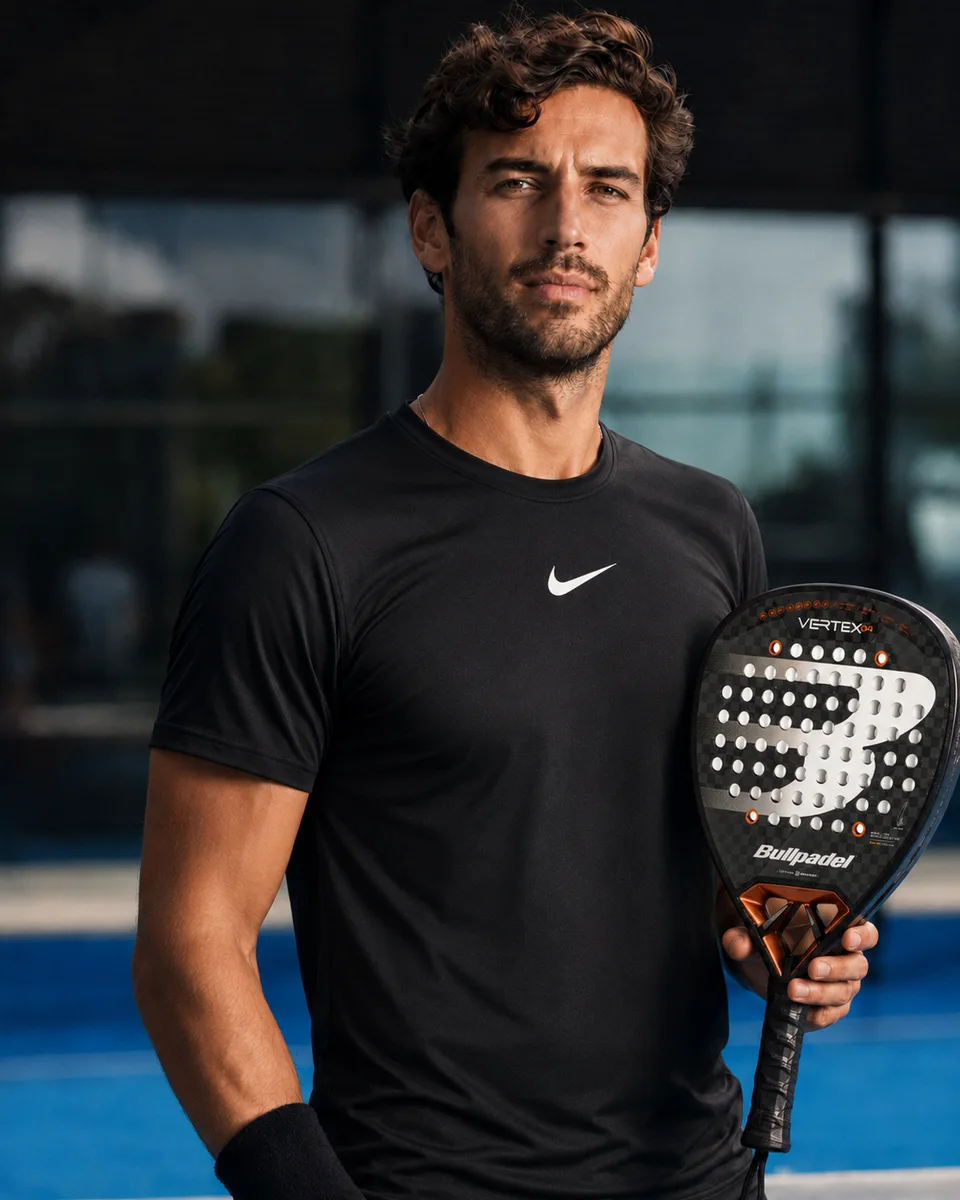
A padel racket is a solid, perforated bat made of carbon fiber or fiberglass around a foam core, weighing roughly 350–370 grams. It has no strings; power and feel come from the foam and face material. A pickleball paddle is flat, rigid, and light, around 200–230 grams, built from a polymer honeycomb core with a composite face. Neither works for the other sport, and neither has anything to do with a tennis racket.
A padel ball is a pressurized rubber-and-felt ball, visually a tennis ball, but with slightly less pressure so it comes off the glass at a playable speed. A pickleball is a hollow hard-plastic ball with 26–40 holes that barely bounces and hangs in the air. The balls alone tell you the story: padel is a bounce-and-rebound game, pickleball is a reflex-and-placement game.
Rules: The Two Signature Differences
Beyond the shared underhand serve, the rules diverge at two points that define each sport:
Put simply: padel's defining rule adds a dimension (the walls), while pickleball's defining rule removes one (the smash at the net).
- Padel's walls are in play. After the ball bounces, you can play it off your own back or side glass, and advanced players deliberately use the glass for defense and angles. Padel also uses tennis scoring, so a match feels like a doubles tennis match inside a squash court.
- Pickleball's kitchen forbids net-crashing. You cannot volley while standing in the no-volley zone, and the double-bounce rule means the serve and the return must each bounce. Both rules exist to neutralize power and force the soft "dink" game that defines pickleball.
Which Is More Popular: Padel or Pickleball?
In the United States, pickleball is far bigger, but the gap is closing faster than most people realize. The same SFIA survey (2026 Topline Participation Report) counted 24.3 million American pickleball players and 1.07 million American padel players in 2025, a 23-to-1 gap, measured by identical methodology in the same year.
Search interest tells a different story about momentum. US Google searches for pickleball outnumbered padel searches 23-to-1 in 2023 but only 8-to-1 by mid-2026, pickleball's search demand grew about 5% over that window while padel's grew about 150%. In other words, American interest in padel is running well ahead of American participation, the classic profile of a sport whose bottleneck is court supply, not demand.
Globally, the picture inverts. Padel counts an estimated 25–30 million players across 90+ countries and 77,300 courts worldwide, and it's the second sport in Spain behind soccer, with 12.7% of Spaniards playing. Pickleball, for all its scale, remains overwhelmingly a North American phenomenon. Pickleball is bigger in America; padel is bigger everywhere else.
Choose Padel If You Want This
Choose padel if you:
- Want longer rallies and a more athletic, three-dimensional game
- Come from tennis or squash and want your instincts to (mostly) transfer
- Want a sport with years of skill ceiling ahead of you
- Live near one of the 1,000+ US courts, Florida, Texas, and California hold about 70% of them
Choose Pickleball If You Want This
Choose pickleball if you:
- Want the absolute lowest barrier, free public courts in almost every town
- Prefer a compact, low-impact game that's easy on the shoulders and knees
- Want singles as an option, padel is doubles-only in practice
- Want to play tomorrow without booking anything
Or Don't Choose At All
Or don't choose. The skills barely overlap, the seasons don't conflict, and a growing number of American clubs now build both courts side by side.
Can Pickleball Players Switch to Padel?
Yes, and they adapt faster than tennis players in one specific way: pickleball players already respect the soft game. The patience learned at the kitchen line translates directly to padel's net exchanges. What needs rebuilding is everything spatial: a padel court is 2.5 times bigger, the ball bounces and rebounds, and overhead smashes, nearly absent from pickleball, become a core weapon. If you're making the jump, start with our guide to getting started with padel and rent a racket before buying one.
Related Guides and Tools
Next step
How to get started playing padel
Use this next if you want to turn the guide into a shortlist or a direct product decision.
Next step
How to choose your first padel racket
Use this next if you want to turn the guide into a shortlist or a direct product decision.
Next step
Padel balls guide: pressurized vs control
Use this next if you want to turn the guide into a shortlist or a direct product decision.
Sources Used
For health-related context, I checked clinical sources and kept the buying advice conservative. This page is not medical advice.
- SFIA 2026 Topline Participation Report: US pickleball participation (24.3M players, +22.8% YoY)
- USPA / SFIA: padel participation in the United States (1,073,000 players, 2025)
- PadelTennisReviews.com: "Padel in the USA: Growth Statistics 2026", search-demand ratios and US court counts (original Ahrefs analysis)
- FIP World Padel Report 2025: global court count (77,300) and international footprint
Padel vs Pickleball: What's Actually Different? FAQ
Is padel harder than pickleball?
Padel is slightly harder to learn and much deeper to master. Both sports allow beginners to rally on day one, but padel adds walls, tennis scoring, and overhead play, which take longer to learn, and give the sport a higher ceiling.
Can you play pickleball on a padel court?
No. A padel court is more than twice the size, has walls, and uses a higher net. Some clubs paint temporary pickleball lines on other surfaces, but the two courts are not interchangeable.
Why is padel more popular than pickleball in Europe?
Padel arrived in Spain in the 1970s and had a fifty-year head start, professional tours, and celebrity adoption across Europe and Latin America. Pickleball's infrastructure, media, and governing bodies grew up almost entirely inside the United States.
Is padel or pickleball a better workout?
Padel generally demands more: the court is larger, rallies are longer, and the game includes sprints, lunges, and overhead shots. Pickleball is gentler on the body, a genuine advantage for many players, not a criticism.
Which is growing faster, padel or pickleball?
In percentage terms, padel. US pickleball participation grew 22.8% in 2025 from a huge base, while padel search demand has compounded at roughly 62% per year since 2019 from a small one. Pickleball is the bigger wave; padel is the steeper one.